Table Content of SalesBlink Sales Automation
What Is SalesBlink?
How Does SalesBlink Sales Automation Work?
Key Features of SalesBlink
- Lead Generation
- Email Finder & Verification
- Cold Email Outreach
- Automated Follow-Ups
- AI-Powered Personalization
- LinkedIn Outreach
- Email Warm-Up & Deliverability
- Unified Inbox
Benefits of Using SalesBlink for B2B Sales
How to Create a Sales Campaign With SalesBlink
How SalesBlink Helps Automate Cold Email Outreach
SalesBlink for Lead Generation
SalesBlink Email Automation Best Practices
SalesBlink Pricing and Plans
SalesBlink Pros and Cons
SalesBlink vs. Traditional Sales Outreach
Who Should Use SalesBlink?
How to Get Better Results With SalesBlink
Final Verdict: Is SalesBlink Worth Using?
Frequently Asked Questions About SalesBlink
In modern B2B sales, finding the right prospects is only half the battle. SalesBlink Sales Automation helps businesses streamline lead generation, personalized outreach, automated follow-ups, and sales engagement from one platform.
SalesBlink enables sales teams to discover leads, create personalized outreach sequences, manage conversations, and generate more sales meetings. By reducing repetitive manual tasks, SalesBlink Sales Automation allows sales professionals to focus on qualified prospects and meaningful customer conversations.
Get SalesBlink Sales Automation Lifetime Deal
What Is SalesBlink?
SalesBlink is a sales outreach platform built around B2B prospecting and cold email campaigns.
The platform helps sales professionals move through several important stages of the outbound sales process, including lead generation, email personalization, automated follow-ups, campaign management, and conversation management.
For businesses that depend on outbound sales, this can reduce repetitive work and give sales representatives more time to focus on qualified prospects and meaningful conversations.In modern B2B sales, finding the right prospects is only half the battle. The bigger challenge is reaching those prospects at the right time, with the right message, and following up consistently without overwhelming your sales team.
This is where SalesBlink Sales Automation can make a significant difference. By combining lead generation, personalized outreach, automated follow-ups, and sales engagement tools, businesses can create a more efficient and scalable outbound sales process.
SalesBlink is an AI-powered sales outreach platform designed to help businesses discover leads, build personalized outreach sequences, manage conversations, and generate more sales meetings. With SalesBlink Sales Automation, sales teams can streamline key parts of their outbound workflow from a single platform instead of relying on disconnected tools and repetitive manual tasks.
For businesses looking to improve their B2B prospecting and outreach strategy, understanding how SalesBlink works—and how its automation features can support the sales process—is an important first step.
Why Sales Outreach Automation Matters
Traditional outbound sales often involve a long list of repetitive activities:
- Finding potential customers
- Researching prospects
- Verifying contact information
- Writing individual emails
- Scheduling follow-ups
- Tracking responses
- Managing multiple campaigns
- Updating sales records
When these tasks are handled manually, sales teams can spend more time managing processes than actually selling.
Automation helps create a more consistent workflow. Instead of remembering when to follow up with every prospect, sales teams can build structured sequences that automatically manage scheduled outreach while allowing representatives to step in when a prospect responds.
Key Features of SalesBlink
Lead Generation
Successful outreach starts with the right prospects.
SalesBlink provides tools for organizing leads and creating targeted prospect lists. This allows businesses to focus their campaigns around specific customer profiles instead of sending generic messages to large, unqualified audiences.
A well-defined Ideal Customer Profile (ICP) should always come first. Factors such as industry, company size, job title, location, and business needs can help determine which prospects are most likely to be a good fit.
Personalized Cold Email Sequences
Sending one email is rarely enough to start a B2B conversation.
SalesBlink allows users to create multi-step email sequences that combine initial outreach with follow-ups. Sequences can be created from templates, built from scratch, or generated with AI assistance.
The objective should not be to send as many emails as possible. Instead, effective sequences should provide relevant information, address a specific problem, and give prospects a clear reason to respond.
AI-Assisted Outreach
AI can make the process of creating sales emails faster.
SalesBlink includes AI-assisted options for creating outreach templates and sequences. This can help sales teams develop campaign messaging without starting every email from a blank page.
However, AI should support personalization rather than replace it. The strongest campaigns combine automation with relevant information about the prospect and their business.
Follow-Up Automation
Many sales opportunities are lost simply because follow-ups are inconsistent.
A prospect may be interested but busy. Another may need additional information before responding. A structured follow-up sequence keeps the conversation moving without requiring sales representatives to manually track every contact.
SalesBlink’s sequence builder supports automated steps, delays, conditions, and tasks, giving teams more control over how their outreach campaigns operate.
LinkedIn Outreach Tasks
B2B prospecting does not always have to rely on email alone.
SalesBlink can incorporate manual LinkedIn tasks into outreach sequences, allowing sales representatives to coordinate email campaigns with LinkedIn activities.
A multi-channel approach can make outreach feel more natural when each interaction provides additional value instead of simply repeating the same sales pitch
Email Deliverability Tools
Even an excellent sales email is useless if it never reaches the prospect’s inbox.
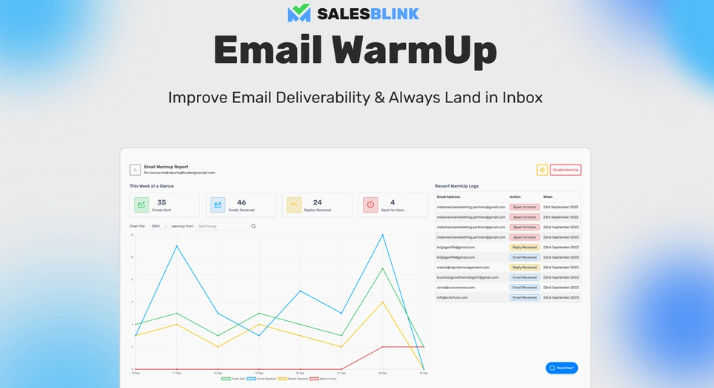
SalesBlink provides features designed to support email deliverability, including email warm-up and sender-management capabilities. Its current guidance also emphasizes configuring authentication and gradually building sender reputation before scaling campaigns.
Businesses should treat deliverability as a long-term responsibility. Sending relevant emails to targeted prospects, maintaining healthy sending practices, and following applicable email regulations are essential for sustainable outbound sales.
Unified Inbox
Managing replies across different campaigns can quickly become complicated.
SalesBlink provides a unified inbox for organizing and responding to lead conversations. This helps sales teams keep track of responses without constantly switching between different campaign interfaces.
Centralizing conversations can also make it easier for teams to identify interested prospects and move them toward the next stage of the sales process.
How to Build a Successful SalesBlink Campaign
Using an outreach platform effectively requires more than simply uploading a list and pressing “Send.”
Step 1: Define Your Ideal Customer
Start by identifying exactly who you want to reach.
Consider:
- Industry
- Company size
- Job role
- Geographic market
- Business challenges
- Buying signals
- Budget or purchasing ability
The more specific your ICP, the easier it becomes to create relevant messaging.
Step 2: Create a Strong Offer
Your prospect needs a reason to respond.
Instead of simply saying, “We offer sales software,” explain how your solution can solve a specific business problem.
For example:
“Companies spending several hours each week manually managing outbound follow-ups may be able to reduce that workload through automated sequences.”
The offer should focus on the prospect’s situation rather than your company’s features.
Step 3: Build a Targeted Lead List
Quality matters more than quantity.
A smaller list of highly relevant prospects can produce better results than a huge database of people who have little connection to your product.
SalesBlink’s lead and list functionality can help organize prospects before they enter an outreach sequence.
Step 4: Write a Relevant First Email
Your first email should be short, specific, and easy to understand.
A simple structure is:
Personalization → Problem → Value → Call to Action
For example:
“Hi Sarah,
I noticed your team is expanding its outbound sales operation.
Many growing sales teams struggle to maintain consistent follow-ups as their prospect lists increase.
We help B2B teams automate personalized outreach while keeping conversations organized.
Would it be worth exploring how this could fit your current process?”
The goal is to start a conversation—not explain everything about your company in the first email.
Step 5: Add Thoughtful Follow-Ups
Follow-ups should add value rather than simply repeat the original message.
You might:
Share a relevant insight Address a common objection Provide a useful resource Mention a relevant use case Ask a simple follow-up question Avoid sending multiple messages that all say, “Just checking in.”
Step 6: Monitor Campaign Performance
Once your campaign is running, review performance regularly.
Important metrics include:
Delivery rate
Bounce rate
Reply rate
Positive reply rate
Meetings booked
Qualified opportunities
Conversion rate
Revenue generated
The ultimate goal is not simply a high open or reply rate. The real question is whether your outreach generates qualified conversations and paying customers.
Best Practices for Using SalesBlink
Focus on Quality Over Volume
Sending more emails does not automatically mean generating more sales.
A targeted campaign with strong messaging can outperform a massive campaign aimed at poorly matched prospects.
Personalize With Purpose
Personalization should go beyond adding a prospect’s first name.
Mention something genuinely relevant to their company, role, industry, or current business situation.
Keep Emails Concise
Busy professionals rarely want to read long sales pitches.
Make your emails easy to scan and give prospects a simple next step.
Protect Your Sender Reputation
Email infrastructure matters.
SalesBlink’s current documentation recommends proper sender setup, authentication, warm-up, and controlled sending practices as part of building successful cold email campaigns. S SalesBlink Help
Stop When Prospects Respond
Once a prospect replies, automated outreach should not continue as though nothing happened.
SalesBlink’s setup guidance recommends enabling “Stop on reply” so conversations can move from automation to human interaction. S SalesBlink Help
Test and Improve
Do not assume your first campaign will be your best campaign.
Test different:
- Subject lines
- Offers
- Opening sentences
- Calls to action
- Follow-up timing
- Target audiences
Then use the results to improve future campaigns.
SalesBlink Pricing and Plans affihub.io
| Feature | Plan 1 ($79) | Plan 2 ($158) | Plan 3 ($237) | Plan 4 ($316) |
| AppSumo Codes | 1 Code | 2 Codes | 3 Codes | 4 Codes |
| Email Sends | 50,000 / month | Unlimited | Unlimited | Unlimited |
| AI Replies / Mo | ❌ None | Up to 50 | Up to 100 | Up to 250 |
| Placement Tests | ❌ None | 10 / month | 30 / month | 40 / month |
| Workspaces | 1 Workspace | 1 Workspace | 3 Workspaces | 5 Workspaces |
| White Labeling | ❌ No | ❌ No | Yes | Yes |
| AI Credits / Mo | 2,000 / month | 4,000 / month | 6,000 / month | 10,000 / month |
| Verification Credits | 1,000 / month | 2,000 / month | 3,000 / month | 4,000 / month |
Pros & Cons
| Category | Pros (Advantages) | Cons (Disadvantages) |
| Pricing & Value |
• Pay once for lifetime access ($79–$316) instead of monthly subscriptions. • Unlimited email sender accounts across all tiers. |
• Lower tiers lack essential automated reply features. • Requires upfront payment compared to free monthly trials. |
| Email Deliverability |
• Unlimited built-in email warm-up capability. • Sender rotation prevents flagging individual mailboxes. |
• Native email verifier can produce false positives. • Warm-up tool occasionally pauses automatically and needs manual monitoring. |
| AI Capabilities |
• BlinkGPT automates personalized cold email copy. • AI Reply Agent categorizes and responds to replies (Plan 2+). |
• AI Reply Agent unavailable on Plan 1. • Monthly AI credit caps limit heavy automated outreach. |
| Agency Features |
• Multiple isolated workspaces available on higher plans. • White-label option on Plan 3 and Plan 4 for client branding. |
• White-label features restricted to Plan 3 ($237+) and above. • Maximum 5 workspaces included (Plan 4). |
| Platform & Usability |
• All-in-one Master Unibox, meeting scheduler, and sequence builder. • Unlimited contacts and seat users across all tiers. |
• UI can suffer from periodic bugs and glitches after updates. • Built-in prospect search database lacks deep filtering capabilities. |
SalesBlink vs. Manual Outreach
Manual outreach can work, especially for small numbers of highly strategic prospects. However, it becomes difficult to maintain consistency as the prospect list grows.
SalesBlink can help automate repetitive parts of the process while allowing sales professionals to focus on conversations and opportunities.
The biggest advantage is not simply sending emails faster. It is creating a repeatable outbound sales process.
Who Can Benefit From SalesBlink?
SalesBlink can be useful for businesses and professionals that rely on B2B outbound prospecting, including:
- SaaS companies
- Sales development teams
- Marketing agencies
- Lead-generation agencies
- Consultants
- Recruiters
- B2B service providers
- Startup founders
- Business development teams
The platform is particularly relevant for teams that want to build structured cold email campaigns without managing every step manually.
Final Thoughts
SalesBlink Sales Automation helps businesses simplify B2B prospecting, cold email outreach, lead generation, and follow-ups. By automating repetitive sales tasks, SalesBlink allows teams to save time, stay organized, and focus on building meaningful customer relationships. For businesses looking to create a more efficient and scalable outbound sales process, SalesBlink Sales Automation can be a valuable solution.
Frequently Asked Questions About SalesBlink
What is SalesBlink Sales Automation?
SalesBlink Sales Automation helps businesses streamline B2B prospecting, cold email outreach, lead generation, and automated follow-ups.
What is SalesBlink used for?
SalesBlink is used for lead generation, cold email campaigns, personalized outreach, follow-ups, and sales engagement.
Does SalesBlink automate cold emails?
Yes. SalesBlink allows users to create automated cold email sequences and schedule follow-ups.
Does SalesBlink use AI?
Yes. SalesBlink offers AI-powered features to help create personalized sales emails and outreach sequences.
Who should use SalesBlink?
SalesBlink can be useful for sales teams, agencies, SaaS companies, consultants, startups, and other B2B businesses.
Is SalesBlink Sales Automation worth using?
For businesses that depend on B2B outbound sales, SalesBlink Sales Automation can help reduce repetitive tasks, improve outreach efficiency, and create a more scalable sales process.
More Appsumo Deal Visit affihub.io