

This Plerdy Review 2025 introduces a powerful SEO and user behavior analysis tool designed to help website owners grow traffic and conversions. By combining heatmaps, SEO audits, and conversion tracking, Plerdy offers actionable insights for data-driven decisions. In this Plerdy Review 2025, we explore how the platform supports marketers, businesses, and site owners in improving performance. By the end of this Plerdy Review 2025, you’ll understand whether Plerdy fits your SEO and UX optimization goals.
Get Plerdy Review 2025 Appsumo Lifetime Deal
What is Plerdy?
In this Plerdy Review 2025, Plerdy is defined as an all-in-one SEO and UX analytics platform that helps websites understand user behavior and search performance. It provides tools like heatmaps, SEO checker, event tracking, and conversion funnel analysis to improve engagement. This Plerdy Review 2025 explains how Plerdy is used by marketers, agencies, and eCommerce brands to optimize pages efficiently. Overall, this Plerdy Review 2025 shows why Plerdy is valued for combining SEO data with real user insights.
Best for
- Ecommerce
- Marketers
- Product managers
Integrations
- Google Search Console
- Mailchimp
- Semrush
- Shopify
- WordPress
Alternative
- Hotjar
Key Feature
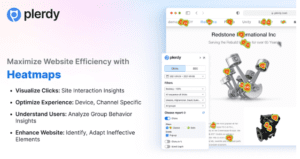
Here are some key features of Plerdy — a powerful all‑in‑one platform for website analytics, UX optimisation & SEO.
-
Heatmaps & Click Tracking:
Visualise where users click, scroll and hover on your site, with segmentation by device and traffic source.
-
SEO Audits & On‑Page Checker:
Automatically detect metadata issues, broken links, duplicate content, missing tags and more to keep your site search‑engine‐friendly.
-
Conversion Funnel & Event Tracking:
Set up goals, monitor user flows, see where visitors drop off, and track specific actions like form submits or button clicks.
-
Session Recordings & UX Insights:
Record real‑user sessions to identify friction points and usability issues, helping you refine user experience.
- Pop‑ups & Lead Capture Tools: Built‑in tools to create pop‑ups, forms and feedback widgets triggered by behaviour to generate leads or feedback.
-
No‑Code Setup & Dynamic Element Support:
Easy to install and configure (often in minutes), with support for dynamic website elements (pop‑ups, dropdowns, single‑page apps).
-
Integrations & Automation:
Connects with tools like Zapier, Airtable, Klaviyo etc for workflow automation and data flow.
Price:
| Plan
|
Monthly Price (Approx. USD)
|
Daily Heatmap Limit
|
Total Video Sessions (Monthly)
|
Key Features / Notes
|
| Free
|
$0
|
100
|
500
|
Includes basic limits for all tools, 1 month storage. Great for small sites or testing.
|
| Startup
|
$32
|
500
|
5000
|
Good entry point for small businesses; includes 3 months storage.
|
| Scale
|
$64
|
1,500
|
10,000
|
Most Popular. Significant increase in limits, 6 months storage. Best for growing websites.
|
| Thrive
|
$108
|
3,000
|
3,0000
|
Multiple tiers with increasing capacity, 12 months storage, and more AI UX Assistant add-ons.
|
| Enterprise
|
Starts at $148
|
7,000+
|
55,000+
|
Multiple tiers with increasing capacity, 12 months storage, and more AI UX Assistant add-ons.
|
Ideal For
- Marketers & Digital Agencies: Track campaigns, optimize landing pages, and improve conversions.
- UX/UI Designers: Analyze user behaviour with heatmaps and session recordings to enhance site experience.
- SEO Professionals: Conduct automated on-page SEO audits and fix technical issues.
- E‑commerce Teams: Understand visitor flows, reduce drop-offs, and increase sales.
- Small to Medium Businesses: Get an all-in-one solution without juggling multiple tools.
Pros
- Intuitive and user‑friendly interface that many users say is accessible even for beginners.
- Offers a wide suite of tools in one place (heatmaps, session recordings, SEO checker, pop‑ups), reducing the need to use multiple systems.
- Strong value for money — users mention that for its feature set, the pricing is competitive.
- Real‑time or near‑real‑time insights into visitor behavior (clicks, scrolls, session recordings) which help improve UX and conversions
- Lightweight script / minimal impact on website load‑speed, according to some users.
Cons
- The dashboard and larger features can be slow to load, especially when dealing with session recordings or large data sets.
- Setup and configuration may be complex for beginners, particularly for advanced tracking or funnel features.
- Some users feel the product may be expensive for small businesses or those on tight budgets.
- Documentation and help guides are sometimes considered insufficient or outdated by users who needed guidance
Verdict
In conclusion, this Plerdy Review 2025 shows that Plerdy is a strong solution for improving SEO and user engagement through behavior-driven insights. Its mix of analytics, optimization tools, and easy-to-read reports makes it suitable for both beginners and professionals. This Plerdy Review 2025 also highlights that consistent use can lead to better conversions and smarter design decisions. Ultimately, this Plerdy Review 2025 confirms that Plerdy is a valuable tool for long-term website growth.
FAQ
Q: How do I install Plerdy tracking code on my website?
A: Navigate to Settings → List of Websites in your Plerdy account. You will find your tracking code which you need to insert into your site’s header. Once installed, data collection begins.
Q: Does Plerdy slow down my website’s performance?
A: No—Plerdy’s tracking script is designed to load after the page has fully loaded and uses modern technologies like HTTP/3 to minimize performance impact.
Q: Can I get a refund if I’m not satisfied?
A: Yes—Plerdy offers a refund within 30 days of purchase if it does not meet your expectations.
Q: How often are SEO audits performed by Plerdy?
A: SEO data is collected daily, provided the page receives at least one visit, so you regularly get updated on site health.
Q: Are user sessions recorded, and how can I view them?
A: Yes—Plerdy includes session recordings. To view them, you need to set up which pages or user segments are recorded under Video > Set up. Then go to Video > Reports to view sessions.
Q: Can I track multiple domains in one account (cross‑domain tracking)?
A: Yes. By using the same tracking code across multiple domains and enabling cross‑domain tracking in Settings → Cross‑domain Tracking, you’ll see combined data across the domains.